Are You the Bottleneck in Your Own Business?
Here's an uncomfortable question to start your day: if you disappeared for a month - no phone, no email, genuinely unreachable - would your business still be running when you got back?
Not "would it survive." Would it run. Jobs quoted, work scheduled, customers looked after, decisions made, invoices out the door.
For a lot of trade business owners, the honest answer is no. And that's not a sign you've failed. It's usually a sign you've succeeded - you're brilliant at running your business. But here's the trap nobody warns you about: being brilliant at running it is often the very thing keeping it small.
The hub and spoke problem
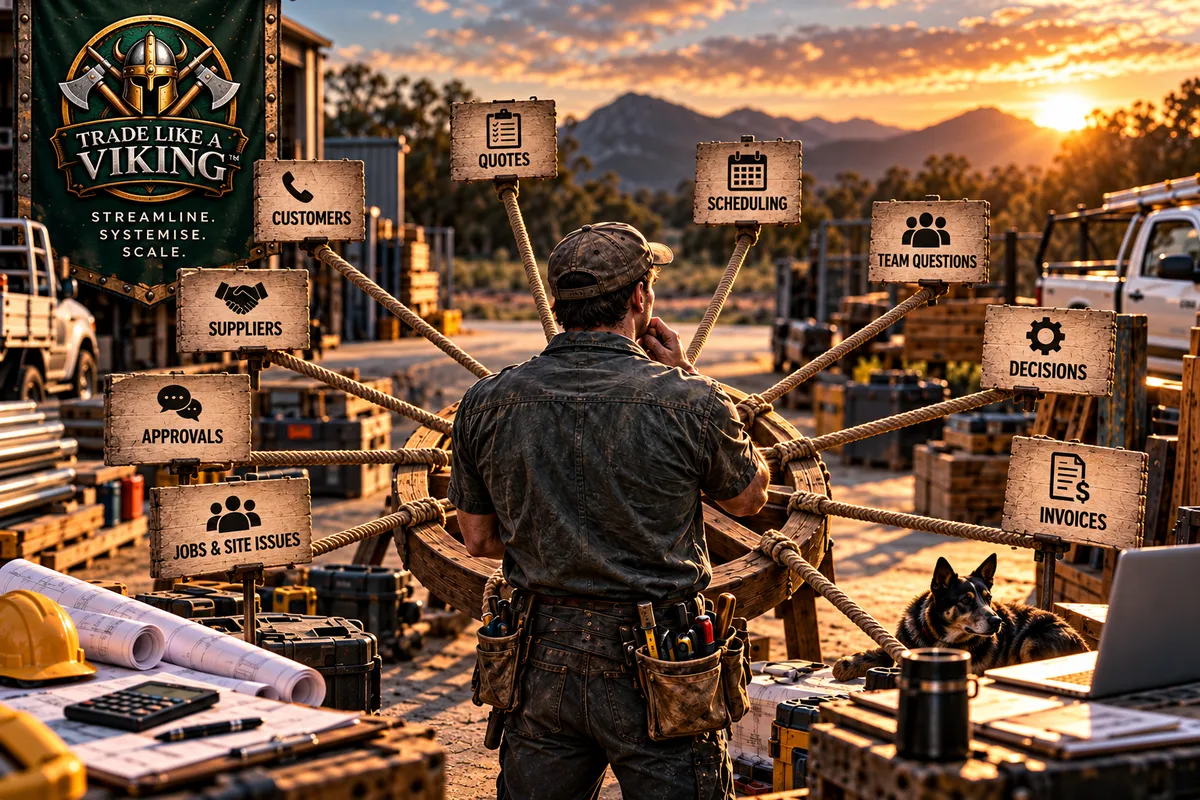
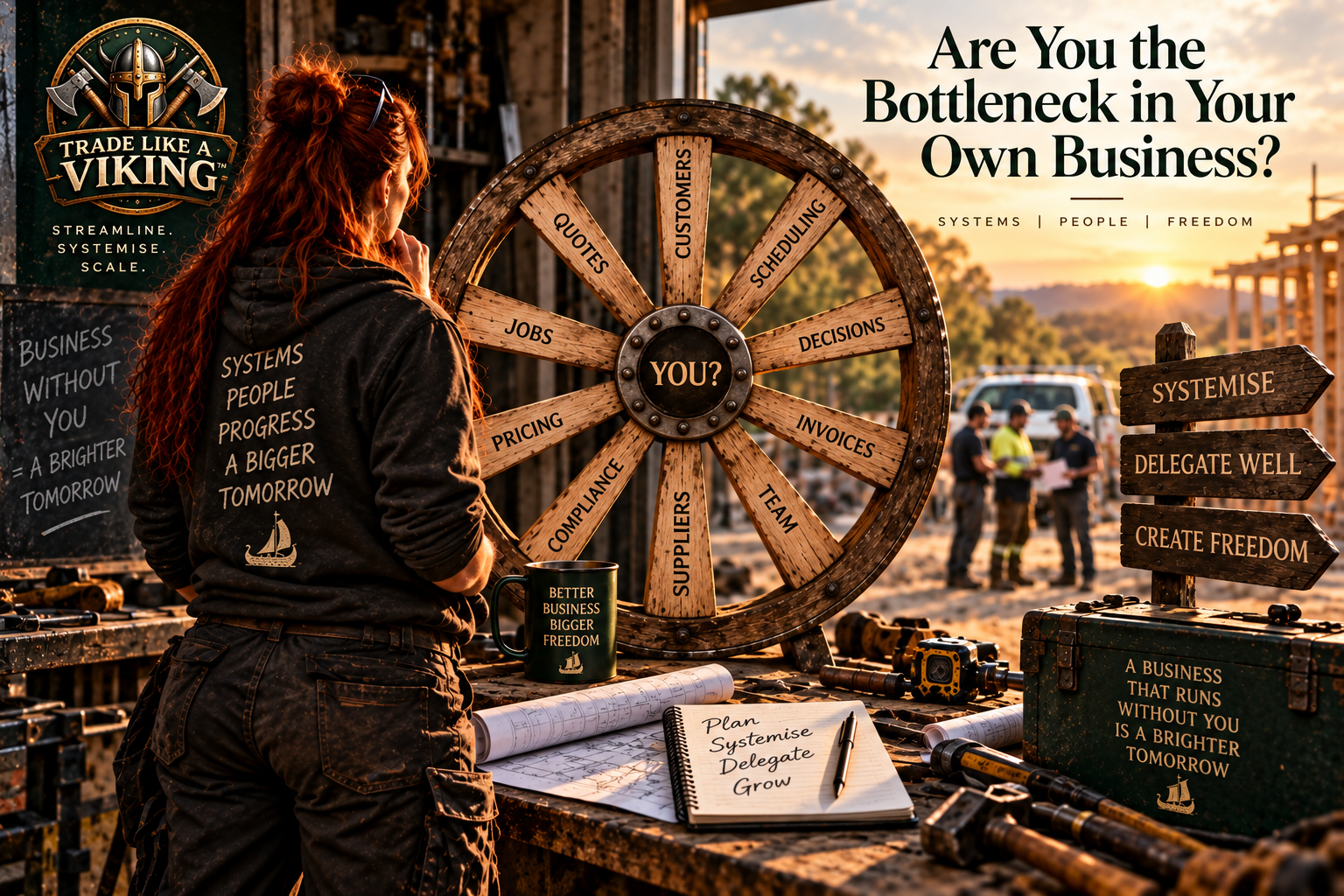
Picture a wagon wheel. You're the hub in the centre. Every spoke - every customer, every quote, every pricing call, every "just check with the boss" - runs back through you.
While you're there spinning, it works. It might even work well. But the whole wheel depends on the hub never stopping. Take a holiday and the spokes wobble. Get sick and things start dropping. Try to grow, and you can't - because there are only so many spokes one hub can hold.
That's owner dependency, and it's the single most common ceiling I see trade businesses hit. Not lack of work. Not lack of skill. The business simply can't get bigger than the owner's personal capacity, because everything routes through one person.
What it's quietly costing you
Let's talk about the number, because it's bigger than most owners realise.
Business buyers have studied this to death, and the research is brutally clear. Businesses that can run without the owner are valued at around 4.49 times pre-tax profit, versus 2.93 times where the owner knew every customer personally. One advisory group put it even more starkly: a highly owner-dependent business might sell at a 2x earnings multiple where a comparable, well-systematised business sells at 4x - on $1M in earnings, that's a $2M difference in the purchase price.
Now, you might not be selling any time soon. But that gap isn't really about selling. It's a measure of how much of your business's value lives in you instead of in the business. And whether you sell tomorrow or in twenty years, a business that only works when you're in the room is a fragile one - one bad back, one family emergency, one burnout away from trouble.
The buyers are just the ones honest enough to put a price on it.
"But I've delegated!"
This is where a lot of owners push back - and it's an important distinction, because it's the one that actually fixes the problem.
Delegation isn't the same as removing yourself as the bottleneck. Delegation moves tasks from your plate to someone else's. But if every one of those tasks still bounces back to you for a decision, an approval, a "how do I handle this one" - you haven't removed the bottleneck. You've just added a step to it.
The real fix isn't handing out tasks. It's building the business so it doesn't need you for the day-to-day at all. Documented processes, so the answer to "how do we do this" lives in the system, not in your head. Decision-making frameworks, so your team can make the call without escalating. Client relationships that belong to the business, not to your personal mobile number.
That's not delegation. That's designing yourself out of the daily grind - and into the strategic seat where you actually belong.
Where to start
You don't fix this overnight - genuinely reducing owner dependency takes time, and it has to feel natural rather than sudden. But you can start this week, and the first step is just seeing it clearly.
For one week, keep a note every time someone needs you - every approval, every question only you can answer, every "let me just check with him." Don't change anything yet. Just watch.
At the end of the week you'll have a map of your own bottlenecks. And most of them will fall into a few buckets: knowledge that lives only in your head, decisions only you're allowed to make, and relationships only you hold. Each of those has a fix - documenting the knowledge, setting the decision rules, transferring the relationships - and each one you solve is a spoke that no longer needs the hub.
The goal was never to make yourself irrelevant. It's to make yourself unnecessary for the day-to-day - so you're free to do the work only you can do. Growing the thing. Leading it. Building something that lasts.
A business that needs you for everything isn't an asset. It's a job you can't quit.
Let's build you something better.
This is the operational work at the heart of what I do - helping trade and construction businesses build the systems, processes and structure that let the business run without the owner holding every piece. If your business can't run without you, that's not a life sentence. It's a starting point. Let's talk.
