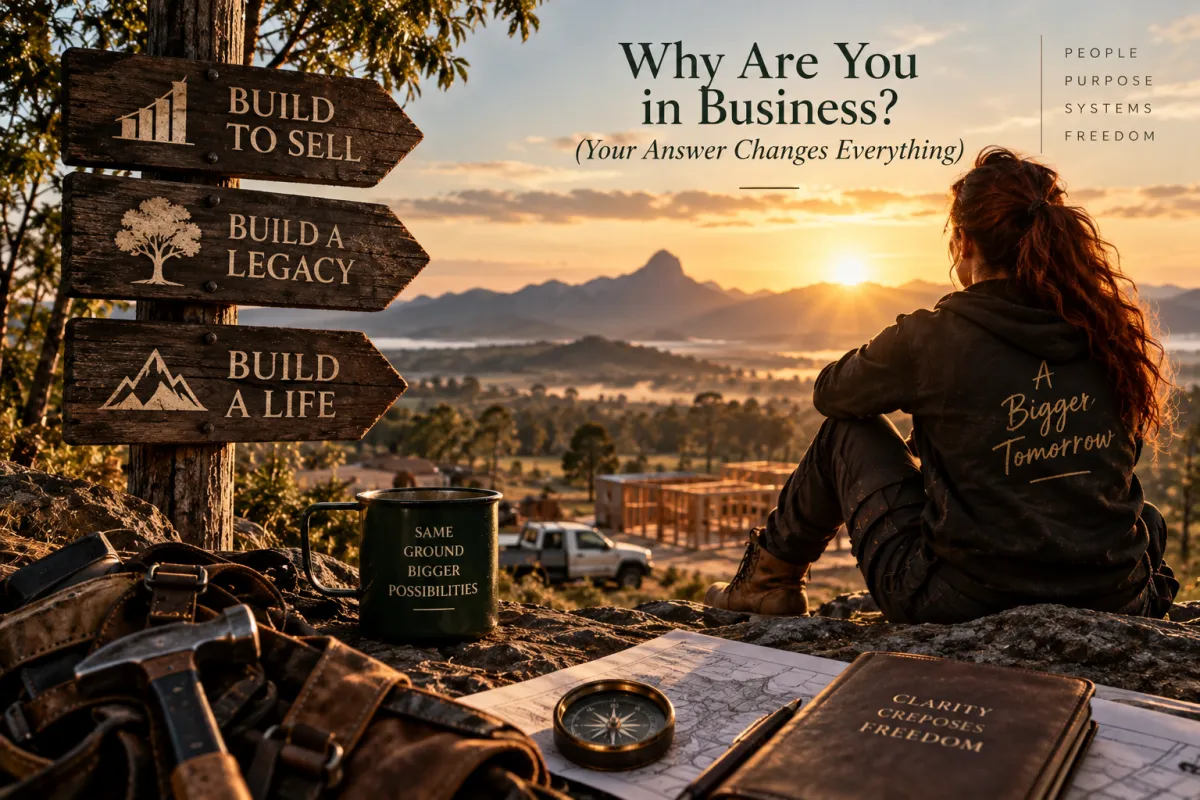
Why Are You In Business?
Why Are You in Business? (Your Answer Changes Everything)
Most trade business owners have never actually answered this question. Not really. They started the business because they were good at the trade, or because they were sick of working for someone else, and then they just... kept going. Head down, next job, next problem.
But there's a question underneath all of it that quietly decides what you should be doing every single day: why are you in business at all?
Not the feel-good version. The real one. Because your honest answer changes what your business needs from you - and most owners are working towards a goal they've never named.
Broadly, there are three answers. None is more noble than the others. But they pull in different directions, and trying to chase all three at once is how you end up exhausted and stuck.
1. You're building to sell
Maybe not tomorrow. But one day, you want to hand over the keys, take the money, and walk away.
If that's you, here's the hard truth: the buyer isn't paying for how hard you work. They're paying for a business that keeps working after you leave. Everything that makes you feel indispensable - you holding every client relationship, every decision routing through you, all the know-how living in your head - is exactly what lowers the price. Buyers apply a discount for owner dependence, and it's a big one.
So if selling is the goal, your job is almost counterintuitive: make yourself unnecessary. Document everything. Build a team that runs the day-to-day. Turn your personal relationships into company relationships. Build the business as if you were leaving next year, because the more it runs without you, the more it's worth.
2. You're building a legacy
Maybe you don't want to sell. You want to hand it to your kids, or your key staff, or simply build something that outlives you and carries your name in the community for decades.
Legacy sounds different from selling, but operationally it needs almost the same thing: a business that doesn't depend on you. You can't hand your children a business that only works because you're the one who works it - that's not a gift, it's a trap with your name on it. A legacy business needs systems, trained people, and leadership that isn't just you, so that when you step back, the thing you built keeps standing.
The difference is the timeline and the heart. With a sale, you're building for a stranger's confidence. With a legacy, you're building for the people you love - which, if anything, is a higher bar.
3. You're building a life
And maybe you don't want to sell or build a dynasty. You want the business to fund a good life - freedom, time, enough money to do what matters - for as long as you choose to run it. Then one day you'll wind it down and that's fine.
This is a completely legitimate answer, and plenty of the happiest owners I know are in this camp. But it has a trap of its own: if the business only works when you're chained to it, it's not funding a life - it's consuming one. The whole point was freedom, and instead you've built the best-paying job you'll never be allowed to leave.
So even here - maybe especially here - you need the business to run without you. Not so you can sell it. So you can actually live while you own it. Take the holiday. Coach the footy team. Be home for dinner. That only happens if the wheel keeps turning when you step away.
Notice the thread
Here's what's remarkable. Three completely different reasons for being in business - sell, legacy, life - and every single one points to the same operational truth:
Build a business that doesn't depend on you.
To sell it well, it can't depend on you. To pass it on, it can't depend on you. To actually enjoy the life it funds, it can't depend on you. The "why" changes the timeline, the emotion, and a few of the specifics. But the core work is the same, and it's the work most owners keep putting off: systems, documented processes, a capable team, relationships that belong to the business.
So - why are you in business?
Sit with it. Genuinely. Because until you answer it, you're making daily decisions without knowing what you're aiming at - and it's very easy to spend twenty years building the wrong thing.
Once you know your why, the priorities get clear fast. You stop doing busywork that serves no version of your future, and you start building deliberately towards the one you actually want.
Whatever your answer, the foundation is the same. The business has to be able to stand on its own.
And that's buildable. It's exactly the work I do with trade and construction businesses every day.
Not sure which of the three you're building towards - or how to start making your business less dependent on you? That's the conversation I love having. Let's have it.
